By clicking “Accept All Cookies”, you agree to the storing of cookies on your device to enhance site navigation, analyze site usage, and assist in our marketing efforts. View our Privacy Policy for more information.
Chi Sao Training for Beginners Explained
Chi sao training for beginners builds sensitivity, timing, and structure. Learn what to expect, common mistakes, and how real progress happens.
By
May 5, 2026
Related

The first time someone tries chi sao, they usually discover the same thing - strength is not the answer. A beginner may tense up, chase hands, or try to win every exchange. Then, within a few seconds, a more relaxed training partner seems to find the center, control the space, and land cleanly. That is why chi sao training for beginners matters so much. It teaches you to feel pressure, maintain structure, and respond with precision instead of panic.
In authentic Ving Tsun, chi sao is not a game of speed or a contest of reflexes alone. It is a method for developing contact sensitivity, correct position, and efficient forward intent. When taught properly, it helps students understand how the art actually works under pressure. For adults, women, and mature children who want practical skill instead of flashy movement, chi sao becomes a bridge between forms, drills, and real application.
What chi sao really teaches
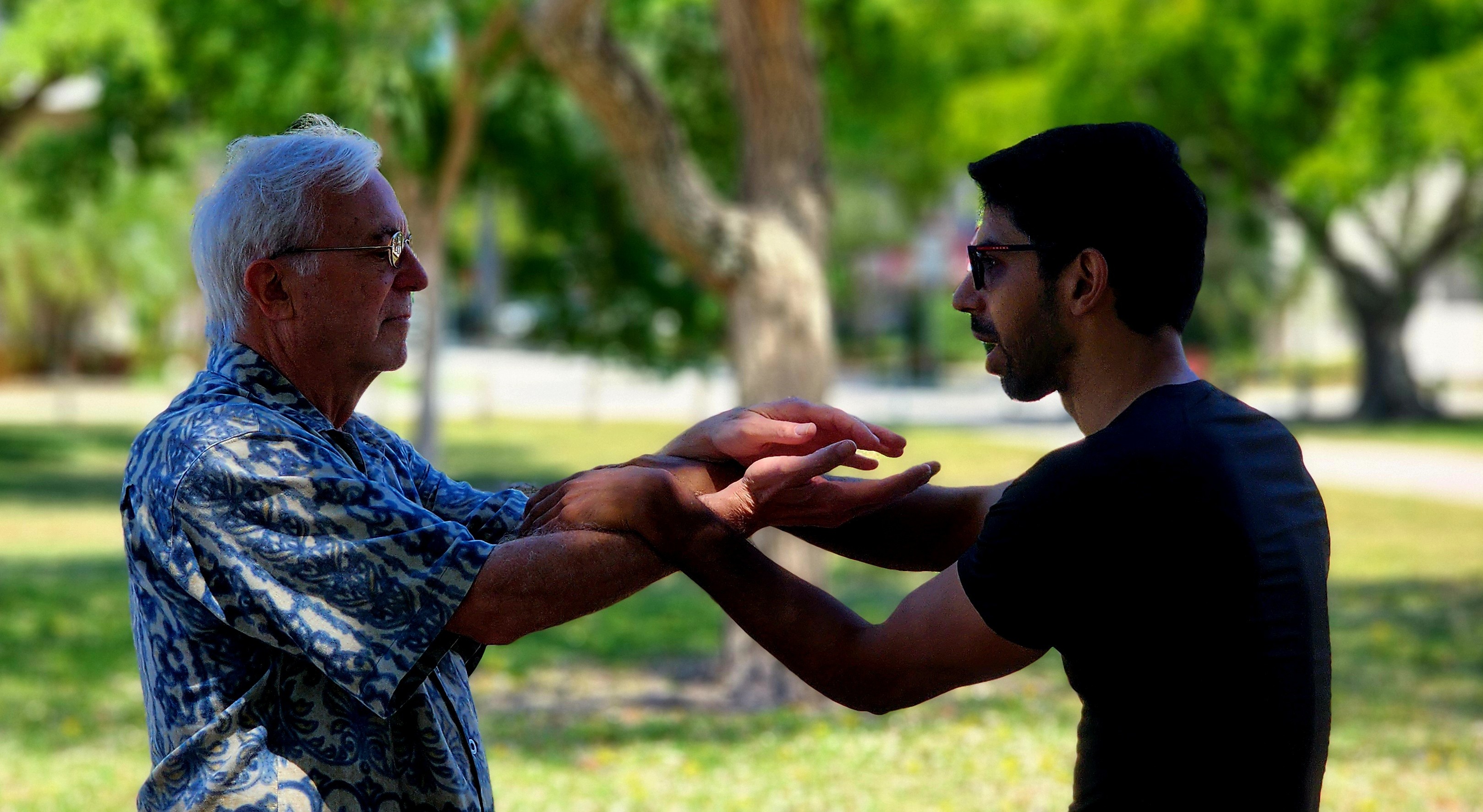
Many people hear chi sao translated as sticking hands and assume it is only about keeping the arms in contact. That is too shallow to be useful. The real purpose is to train sensitivity through touch so you can recognize openings, pressure changes, and structural weaknesses at the moment they appear.
A beginner quickly learns that eyesight has limits at close range. Hands can move faster than the eyes can process. Chi sao trains the body to read information through contact. If your partner pushes, collapses, lifts, or leaves the line, you begin to feel it before you have to think about it. That skill is one reason Ving Tsun has remained respected as a practical fighting system.
It also teaches economy. Instead of making wide movements, beginners are trained to stay on the centerline, protect themselves while attacking, and remove wasted effort. This is where authentic instruction matters. Without the right framework, chi sao can become sloppy hand chasing. With proper lineage-based teaching, it stays connected to the principles that give the drill meaning.
Chi sao training for beginners starts with structure
Before a student can benefit from sensitivity training, the body has to be organized correctly. That means stance, elbow position, relaxation, alignment, and forward energy all need to be introduced with care. If the structure is weak, chi sao becomes a collection of bad habits practiced repeatedly.
Beginners often want to rush into fast rolling hands because it looks advanced. In reality, speed hides mistakes. A new student needs to feel where the elbow belongs, how the wrist stays alive without tension, and how the body supports the arm. Slow practice is not basic because it is easy. It is basic because it builds the conditions that make skill possible later.
This stage can test patience. Some students expect instant fighting ability, while others worry they are moving too slowly. The truth is that good foundations save time. A student who learns correct structure early will usually progress faster than someone who spends months relying on strength and then has to rebuild from the beginning.
Why relaxation is harder than it sounds
Nearly every beginner hears the word relax and thinks they understand it. Then contact begins, pressure rises, and the shoulders lift, forearms harden, and breathing shortens. Relaxation in chi sao does not mean going limp. It means using only the amount of tension needed to maintain position and express force efficiently.
This matters for self-defense. If you become stiff under pressure, you lose sensitivity. If you lose sensitivity, you stop reading your opponent accurately. Relaxation keeps your body available. It lets you adapt instead of freezing into one idea.
What beginners usually practice first
Good chi sao training is structured. Students are not thrown into random exchanges and told to figure it out. They begin with simple positions and repeat them until the body starts recognizing proper lines and pressure.
At first, beginners commonly work on basic rolling patterns, controlled transitions, and isolated responses. The purpose is not memorization for its own sake. The purpose is to create familiarity with contact so the student can develop timing without chaos. As skill improves, more variables are added.
Some schools rush this process. Serious Ving Tsun instruction does not. Classical training respects progression because progression protects the integrity of the art. At Moy Yee Hop Ving Tsun Kung Fu, this type of methodical development reflects the value of preserving the system as it was truly passed down, not watered down for convenience.
The difference between drills and fighting
One of the biggest misunderstandings in chi sao training for beginners is the idea that chi sao is sparring. It is not. Chi sao is a training method that develops attributes needed for fighting, especially at close range.
That distinction matters. If beginners treat every drill like a brawl, they usually become aggressive, disconnected, and careless. If they treat chi sao as dead choreography, they never learn to apply it. The right middle ground is alive but disciplined practice. You train with intent, but you stay within the lesson the drill is meant to teach.
This is also why instructor guidance is essential. A knowledgeable teacher knows when a student needs more repetition, more pressure, or more freedom. Too much intensity too soon can make a beginner defensive and tense. Too little pressure can create false confidence.
Common beginner mistakes in chi sao
The most common mistake is chasing hands. A student feels movement and starts swatting at whatever appears. That breaks structure, opens the center, and turns the drill into a reaction contest. In Ving Tsun, the goal is not to touch every hand. The goal is to control the line and use efficient response.
Another mistake is leaning. Beginners often try to reach with the body instead of maintaining balance and using proper position. Leaning may seem aggressive, but it usually gives away stability and recovery. Against a skilled partner, that becomes an easy opening.
Overcommitting force is just as common. New students often believe stronger pressure creates better control. Sometimes it does the opposite. Excess force makes you easier to read and easier to redirect. A good instructor teaches students how to apply pressure that is purposeful, not excessive.
Finally, many beginners think progress should look dramatic. Real progress in chi sao is often subtle. Your shoulders stay calmer. Your elbows return to the right place more often. You stop flinching at contact. You recognize pressure sooner. Those are serious improvements, even if they are not flashy.
How chi sao helps beyond the drill
For self-defense, chi sao develops composure at close range. That is valuable because many real encounters happen fast and inside comfortable distance. The ability to maintain structure, feel pressure, and respond directly can make a major difference.
For personal development, chi sao builds patience and discipline. You cannot force your way to high-level sensitivity. You have to train consistently, accept correction, and refine the details. That process shapes character as much as skill. Many adults find this especially rewarding because training gives them something rare - a serious path of improvement that engages body, mind, and intention together.
There are physical benefits as well. Beginners often notice better coordination, balance, posture, and body awareness. Women and older adults, in particular, often appreciate that Ving Tsun does not depend on size or athletic explosiveness alone. Proper mechanics and timing matter more than brute force.
How to approach your first months of training
If you are new, your job is not to win chi sao. Your job is to learn how to listen through contact. That means showing up with humility, paying attention to correction, and resisting the urge to turn every exchange into a test.
Train steadily. Ask questions. Focus on clean basics before speed. Work with different partners when appropriate, because each person gives you different feedback through pressure and rhythm. Most of all, trust the process. In a traditional system, skills are layered in the right order for a reason.
Beginners who stay consistent often reach an important turning point. Chi sao stops feeling like confusion and starts feeling like conversation. You begin to sense where force is coming from, where the center is open, and when the path is clear. That moment does not happen by accident. It comes from proper instruction, honest practice, and respect for the art.
If you are considering training, look for a school that treats chi sao as part of a complete Ving Tsun education, not as a flashy add-on. The right environment will challenge you, protect the tradition, and help you build skill that carries into both self-defense and daily life. Good chi sao does more than sharpen your hands - it teaches you how to stay calm, direct, and disciplined when pressure arrives.
.jpg)
.jpg)