By clicking “Accept All Cookies”, you agree to the storing of cookies on your device to enhance site navigation, analyze site usage, and assist in our marketing efforts. View our Privacy Policy for more information.
How to Build Self Defense Confidence That Lasts
Learn how to build self defense confidence through authentic Ving Tsun training, steady practice, awareness, and a supportive Kung Fu community for life.
By
September 18, 2026
Related

Confidence is not the feeling that nothing can go wrong. It is the calm knowledge that you can stay aware, make decisions, and act with purpose when pressure rises. Learning how to build self defense confidence means replacing guesswork with trained habits, one class and one repetition at a time.
For many adults, women, parents, and older students, the goal is not to become aggressive or live in fear. It is to move through daily life with better posture, clearer awareness, and the ability to protect personal space when necessary. Authentic Kung Fu training provides a disciplined path toward that kind of confidence because it develops the body, the mind, and the character together.
Self-Defense Confidence Starts With Reality
False confidence is loud. It often comes from watching a few videos, memorizing a complicated sequence, or assuming fitness alone will solve a stressful encounter. Real confidence is quieter. It comes from admitting that pressure changes how the body responds, then training in a structured environment where those responses can improve.
A practical self-defense system should give students principles they can use rather than a long catalog of moves they may forget. In Ving Tsun Kung Fu, students learn to protect the centerline, maintain balance and structure, and use efficient motion instead of relying on size or strength. The system emphasizes simultaneous attack and defense, helping students understand how to respond without unnecessary movement.
That does not mean every situation has one perfect answer. Distance, surroundings, physical ability, and the behavior of another person all matter. Self-defense confidence grows when you accept this reality and train adaptable principles, not fantasies.
Build Awareness Before You Need It
The first layer of self-defense is awareness. It is not paranoia, and it does not require walking through life tense or suspicious. It is the practice of being present enough to notice what is around you and to trust yourself to make sensible choices.
Start with simple daily habits. Keep your attention off your phone when moving through parking lots, entrances, and unfamiliar areas. Notice exits when you enter a building. Give yourself permission to leave a situation that feels wrong, even if you cannot fully explain why. These decisions are not signs of weakness. They are signs of sound judgment.
Confidence also improves when you practice clear boundaries. A firm voice, direct body language, and the ability to say no without apologizing can prevent many situations from escalating. Martial arts training reinforces this naturally. As students become more organized in their stance and movement, they often become more composed in the way they carry themselves outside class.
Train Your Body to Stay Organized Under Pressure
Fear can make people freeze, rush, overreach, or lose balance. That response is human. The answer is not to shame it away. The answer is to train gradually, with qualified instruction, until calm movement becomes more familiar.
Good training begins with fundamentals. A stable stance teaches you how to remain rooted without becoming rigid. Correct posture improves balance, coordination, and mobility. Repetition teaches the body to move efficiently, so you do not have to invent an answer in the moment.
This is one reason traditional training matters. Students are not simply collecting techniques for a single scenario. They are building a foundation. Forms, drills, footwork, and partner practice each have a purpose. Over time, the body learns alignment, timing, distance, and control.
Physical conditioning supports this work, but it is not the whole picture. Someone can be strong and still panic when their space is challenged. Someone can be smaller or older and still develop meaningful self-defense ability through structure, positioning, awareness, and consistent practice. Training should meet the student where they are while steadily raising their standard.
Why Partner Training Makes the Difference
A self-defense skill is difficult to understand in isolation. Training with a respectful partner shows you how distance changes, how contact affects balance, and how quickly tension can interfere with good movement. It also teaches control, which is essential. The purpose of training is not to prove who is tougher in class. It is to help each student become more capable.
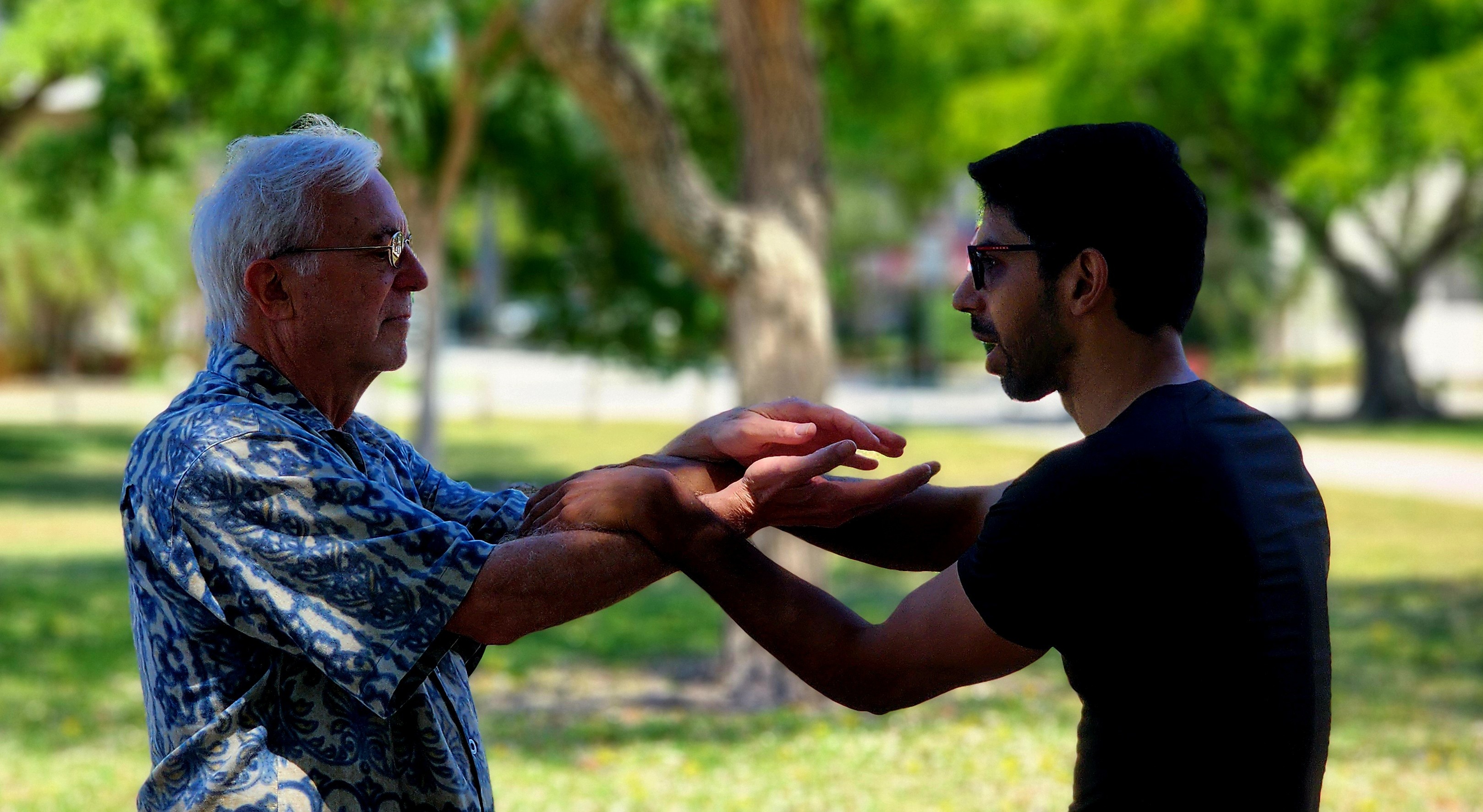
In Ving Tsun, Chi Sao, often called sticky hands training, helps students develop sensitivity, structure, and responsiveness through controlled contact. It is not a substitute for awareness or good judgment. It is a training method that helps students feel pressure, maintain their position, and respond without excessive force or hesitation.
The right school manages this progression carefully. Beginners should not be thrown into chaotic situations before they have basic structure. At the same time, students eventually need enough realistic resistance to understand that self-defense is not performed like a rehearsed demonstration. Confidence comes from bridging that gap safely and responsibly.
How to Build Self Defense Confidence Through Consistency
The biggest change rarely happens in one dramatic class. It happens after weeks of showing up, correcting a stance, repeating a drill, and realizing that what once felt unfamiliar now feels natural. Consistency is where confidence earns its roots.
Set a training rhythm you can maintain. Two focused classes each week may build more lasting progress than an intense burst of training followed by months away. If work, parenting, travel, or physical limitations affect your schedule, be honest about it. A disciplined program should support long-term growth, not demand perfection from the start.
Measure progress by more than belts or techniques. Notice whether you recover your balance more quickly. Notice whether you speak more clearly under stress. Notice whether you enter unfamiliar spaces with better awareness instead of anxiety. These are meaningful signs that training is carrying over into life.
It also helps to let yourself be a beginner. Many adults hesitate to start because they do not want to look uncoordinated or feel behind. Yet everyone who develops skill begins with basic steps. A supportive Kung Fu family gives students room to learn without ego while still holding them to a serious standard.
Choose Instruction With Depth and Accountability
Not all martial arts instruction is designed around the same purpose. Some programs are primarily fitness-focused. Others emphasize competition, performance, or fast promotions. Each may offer value, depending on your goals. But if practical self-defense confidence is your priority, look for instruction that explains why techniques work, tests fundamentals through partner practice, and preserves a clear system of progression.
Lineage matters because it creates accountability. In a traditional system, instructors are responsible for passing on principles accurately rather than changing the curriculum to follow trends. At Moy Yee Hop Ving Tsun Kung Fu, the Moy Yat system is taught as a living tradition, with respect for the structure and principles passed down through Grandmaster Julian Cordero.
Authenticity does not mean training is trapped in the past. It means students receive a coherent method instead of disconnected tricks. The result is a deeper kind of confidence: not the confidence of knowing one flashy response, but the confidence of understanding how your body and mind work together.
Let Confidence Serve Your Life
The best self-defense outcome is often avoiding physical conflict entirely. Training should make you more prepared, not more eager to test yourself. A confident student does not need to posture, seek confrontation, or prove anything to strangers.
This mindset is especially valuable for families. Children and mature teens can learn discipline, respect, coordination, and the importance of speaking up early. Women can develop stronger boundaries and practical skills in a dedicated training environment. Adults and veterans can reconnect with physical capability while building focus and camaraderie. Older students can preserve mobility, balance, and a sense of purpose through lifelong practice.
There will always be uncertainty in the world. You cannot control every person or every circumstance, but you can choose to prepare with patience and discipline. Step onto the training floor, learn the fundamentals well, and allow confidence to grow into something steady enough to carry with you long after class ends.

.jpg)
.jpg)